



News Center
Customized Bottle Options: MOQ, Mold Cost, and Lead Time Explained
Customized Bottle Options: MOQ, Mold Cost, and Lead Time Explained
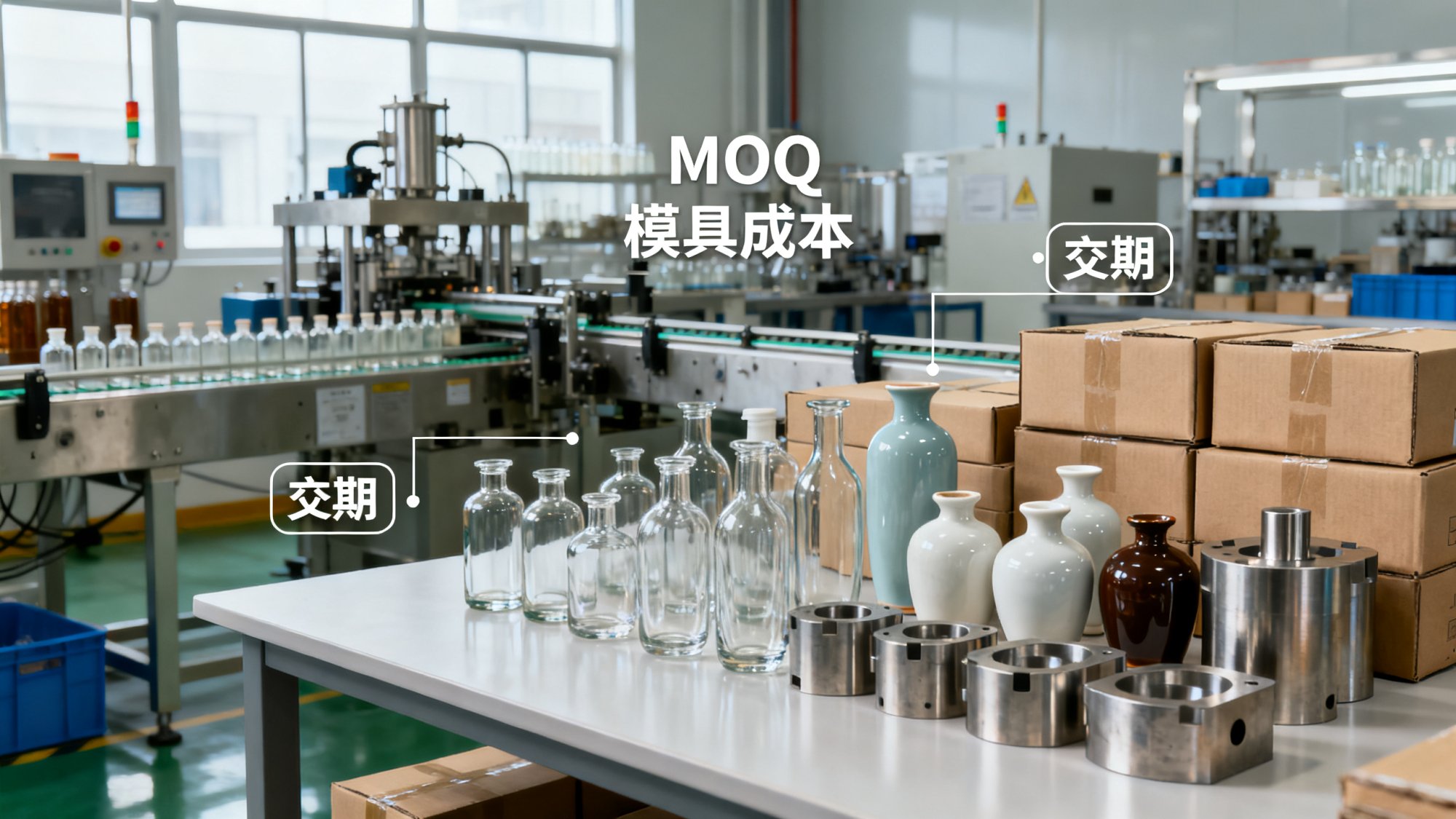
Choosing the right Customized Bottle solution starts with understanding the numbers behind it.
In glass and ceramic materials, three factors shape nearly every sourcing decision.
They are MOQ, mold cost, and lead time.
These numbers affect budget, product feasibility, inventory pressure, and launch timing.
A Customized Bottle may look attractive on paper, yet fail under real commercial conditions.
That usually happens when decision makers compare unit price, but ignore setup cost and production rhythm.
In practice, a better sourcing choice balances customization value with order volume and operational risk.
This guide explains how each element works and how to evaluate a Customized Bottle project with more confidence.
Why MOQ matters in a Customized Bottle project
MOQ means minimum order quantity.
For a Customized Bottle, MOQ is rarely just a sales policy.
It reflects furnace efficiency, forming setup, decoration complexity, and packing workflow.
Glass factories need stable production runs to control waste and energy cost.
Ceramic bottle lines also depend on batch consistency, kiln scheduling, and yield rate.
That is why MOQ often rises when bottle shape, color, finish, or decoration becomes more specific.
A low MOQ can reduce entry risk, but it may increase unit cost sharply.
A high MOQ can improve price, yet create stock pressure if demand is uncertain.
So the real question is not whether MOQ is high or low.
The real question is whether MOQ matches forecast accuracy and replenishment strategy.
What usually increases MOQ
- Unique bottle geometry that needs dedicated tooling.
- Custom glass color, such as amber, matte black, or extra flint.
- Complex surface decoration, including frosting, screen printing, and hot stamping.
- Special closures, inserts, or gift packaging assembled as one set.
- Strict cosmetic standards that lower acceptable production yield.
When comparing suppliers, ask whether MOQ applies to one design, one size, one color, or one shipment.
That detail changes the cost model significantly.
How mold cost changes the total economics
Mold cost is the most misunderstood part of a Customized Bottle purchase.
Many teams treat it as a one-time engineering charge and move on.
But the smarter approach is to spread mold cost across expected lifetime volume.
A bottle mold may be fully justified for a long-running product line.
The same mold can look expensive for a short campaign or regional launch.
For glass packaging, mold cost depends on size, cavity design, neck finish, and structural details.
For ceramic containers, forming method and firing behavior also matter.
This also means a visually simple Customized Bottle can still require careful engineering.
Questions to ask about mold cost
- Is the quoted mold cost for a sample mold or full production mold?
- How many cavities are included in the tooling setup?
- Who owns the mold after payment?
- How long is the mold usable before refurbishment or replacement?
- Are drawing revisions included, or charged separately?
Those answers reveal whether the initial quotation is transparent or only partially complete.
In actual procurement, hidden tooling assumptions often create later budget friction.
When standard bottles may be a better option
Not every project needs a fully customized bottle shape.
Sometimes a standard bottle with custom decoration offers a faster and cheaper route.
This reduces mold cost, lowers MOQ, and shortens launch risk.
If branding impact comes mainly from color, label, closure, or finish, standard packaging can be enough.
That option deserves serious review before approving a new Customized Bottle mold.
Lead time is more than a delivery date
Lead time is often discussed as one number.
In reality, a Customized Bottle timeline has several stages.
These include design review, drawing confirmation, mold production, sample approval, mass production, and shipping.
A supplier may quote attractive production timing, while omitting pre-production steps.
That creates planning gaps, especially for seasonal launches and coordinated packaging programs.
From a sourcing perspective, reliable lead time is often more valuable than the shortest lead time.
This is even more true when the Customized Bottle is only one component in a larger product rollout.
Typical lead time structure
- Concept and technical drawing confirmation.
- Mold fabrication and internal testing.
- Sample production and approval cycle.
- Bulk production scheduling.
- Decoration, inspection, packing, and shipment.
If any step is unclear, the whole Customized Bottle timeline becomes harder to trust.
That is why milestone-based planning works better than a single promised date.
How MOQ, mold cost, and lead time interact
These three factors should never be reviewed in isolation.
A Customized Bottle with low unit price may still be the weaker commercial choice.
For example, high MOQ ties up cash.
A new mold increases upfront investment.
Long lead time reduces flexibility if market demand changes.
On the other hand, a balanced Customized Bottle program can improve branding while keeping supply risk acceptable.
The key is to compare total landed logic, not isolated quote lines.
Looking at the full picture usually leads to a better Customized Bottle decision.
A practical evaluation framework for sourcing
A strong evaluation framework keeps discussions objective.
It also helps compare suppliers offering different Customized Bottle routes.
Use these checkpoints
- Define annual demand, not only first order quantity.
- Separate tooling cost from recurring unit cost.
- Confirm whether samples match mass production standards.
- Check acceptable tolerance, cosmetic criteria, and defect policy.
- Review packaging method and transport protection for fragile goods.
- Ask for milestone dates instead of a single lead time promise.
- Model best case, base case, and slow-sales case.
This approach turns a Customized Bottle quote into a decision model.
That makes internal approval easier and supplier comparison more realistic.
Common mistakes that increase procurement risk
Several sourcing mistakes appear again and again in Customized Bottle programs.
Most are avoidable with better early questions.
- Approving a shape before checking filling, capping, and packing compatibility.
- Comparing quotes without matching decoration scope and quality level.
- Accepting low MOQ offers without confirming actual repeat-order pricing.
- Ignoring mold maintenance and replacement responsibility.
- Treating lead time as fixed even when artwork or samples change.
More importantly, avoid choosing a Customized Bottle based only on visual appeal.
In business terms, packaging has to work as a supply asset, not just a design asset.
Final takeaways for better Customized Bottle decisions
A successful Customized Bottle project starts with clear commercial assumptions.
MOQ defines scale efficiency.
Mold cost defines upfront commitment.
Lead time defines execution flexibility.
When these three align, a Customized Bottle can support branding and supply performance at the same time.
When they do not align, hidden cost appears later through delay, excess stock, or repeated redesign.
Before moving forward, compare at least two sourcing routes.
One should be a fully Customized Bottle solution.
The other should be a standard bottle with selective customization.
That side-by-side review usually reveals the most practical path.
With the right questions and a full-cost view, sourcing becomes faster, clearer, and far more reliable.